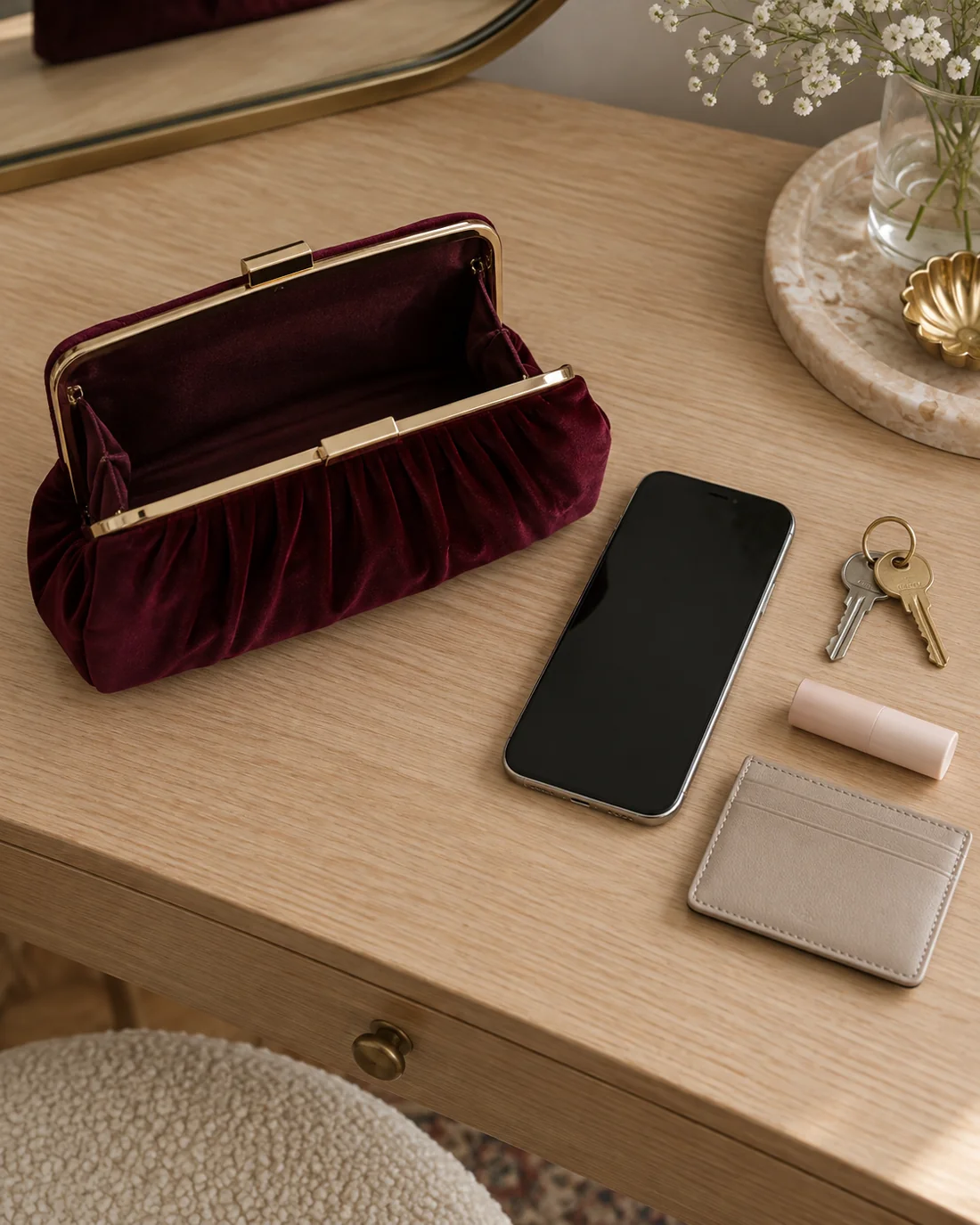
Put the actual items inside
Test the phone with its case on. A small card holder may save room if you need only a few cards. Do not automatically remove everything, though: a required ticket, key or necessary personal item takes priority over an extra cosmetic product. Choose according to your plans rather than aiming for the emptiest possible bag.
Arrange hard items so that they do not press against delicate surfaces. A bunch of keys can occupy a surprising amount of irregular space. If the bag closes only with one exact arrangement, practise taking items out and putting them back several times. You will not always have a clear table available for careful repacking.
Test the carrying method with the outfit
If the bag has a chain, see how it rests against the fabric. A rough link or sharp-edged fitting is a poor companion for a delicate dress. Wear the bag on your shoulder briefly and remove it again. A strap that continually slips towards the neckline may be more distracting against a simple dress than expected.
A clutch without a strap occupies one hand. Consider whether you will also hold a jacket, drink or umbrella. That does not rule out a clutch, but it may decide between two bags you already own. A detachable strap only helps if you bring it and its fastenings close securely.
Do not force every evening requirement into one bag
If you need another layer for the journey home, plan to carry or store it separately. A small bag does not become more suitable when a scarf is trapped between its fastening and lining. For an event, establish what storage is available if that matters to your plan rather than assuming it will be provided.
Finally, close the packed bag normally and walk around the room with it. Take out the phone, put it back and sit down. If the bag remains manageable, that is more useful evidence than its dimensions alone. If it does not, a slightly larger option may be easier to live with, even when the smaller one looks particularly good beside the outfit in a photograph.