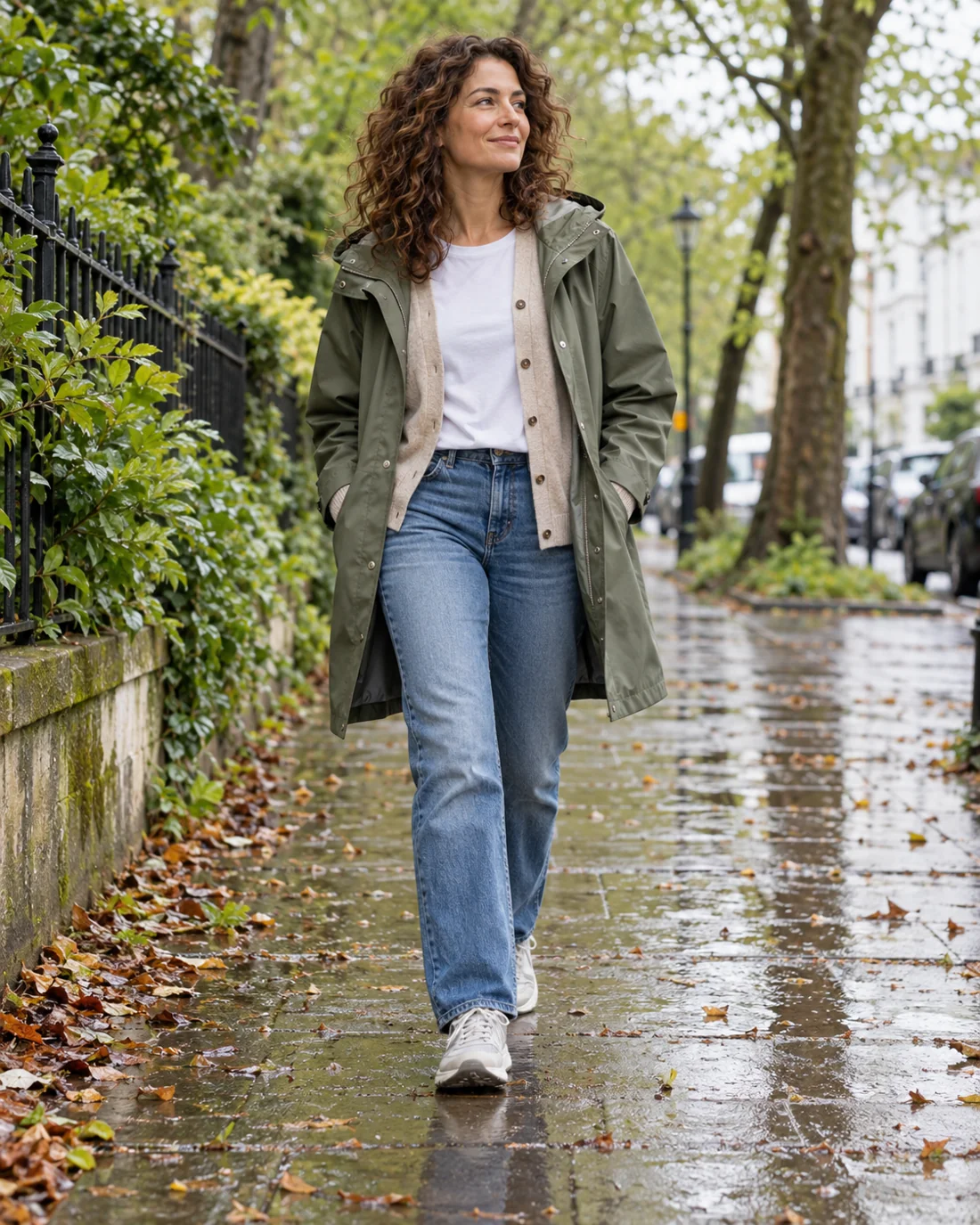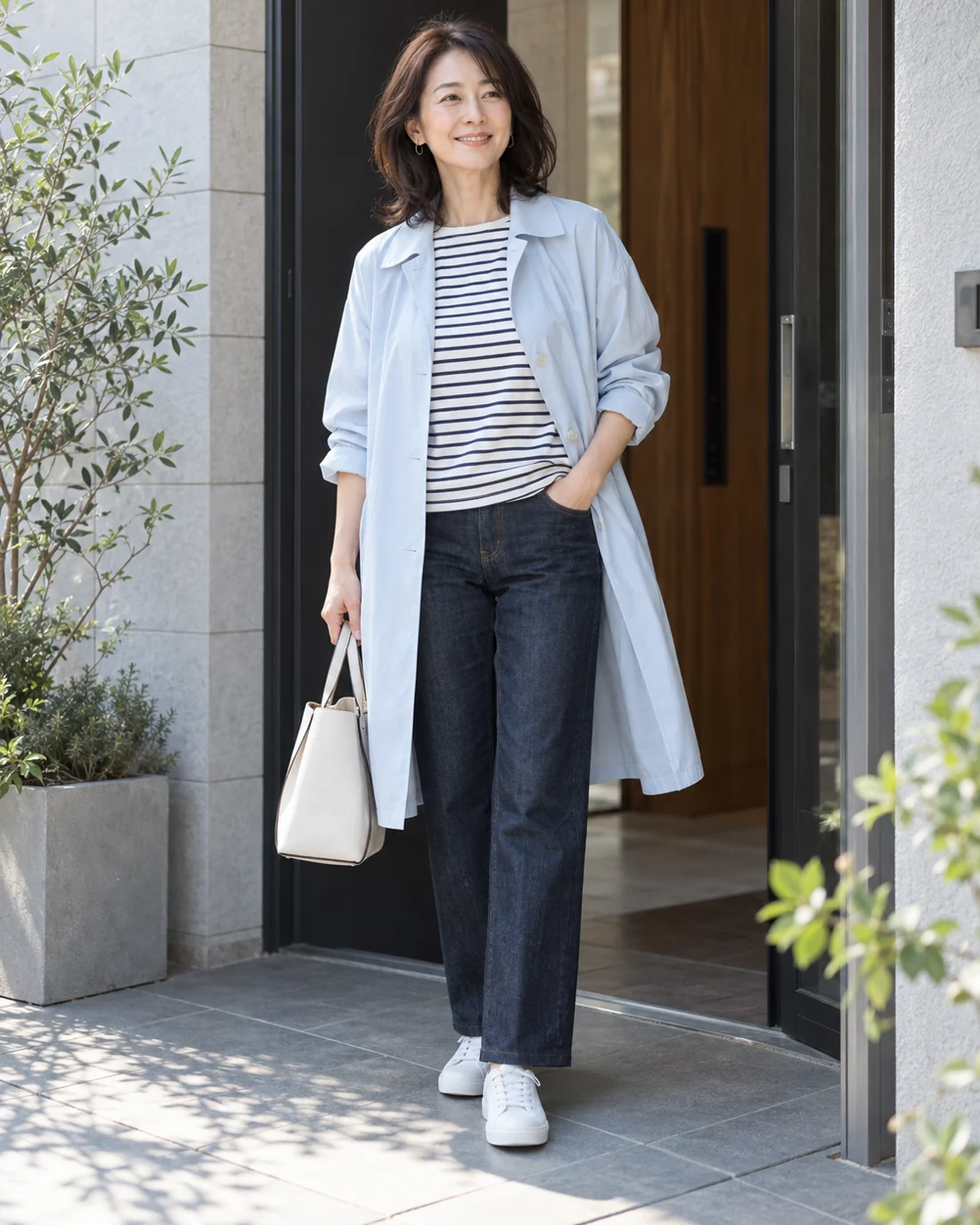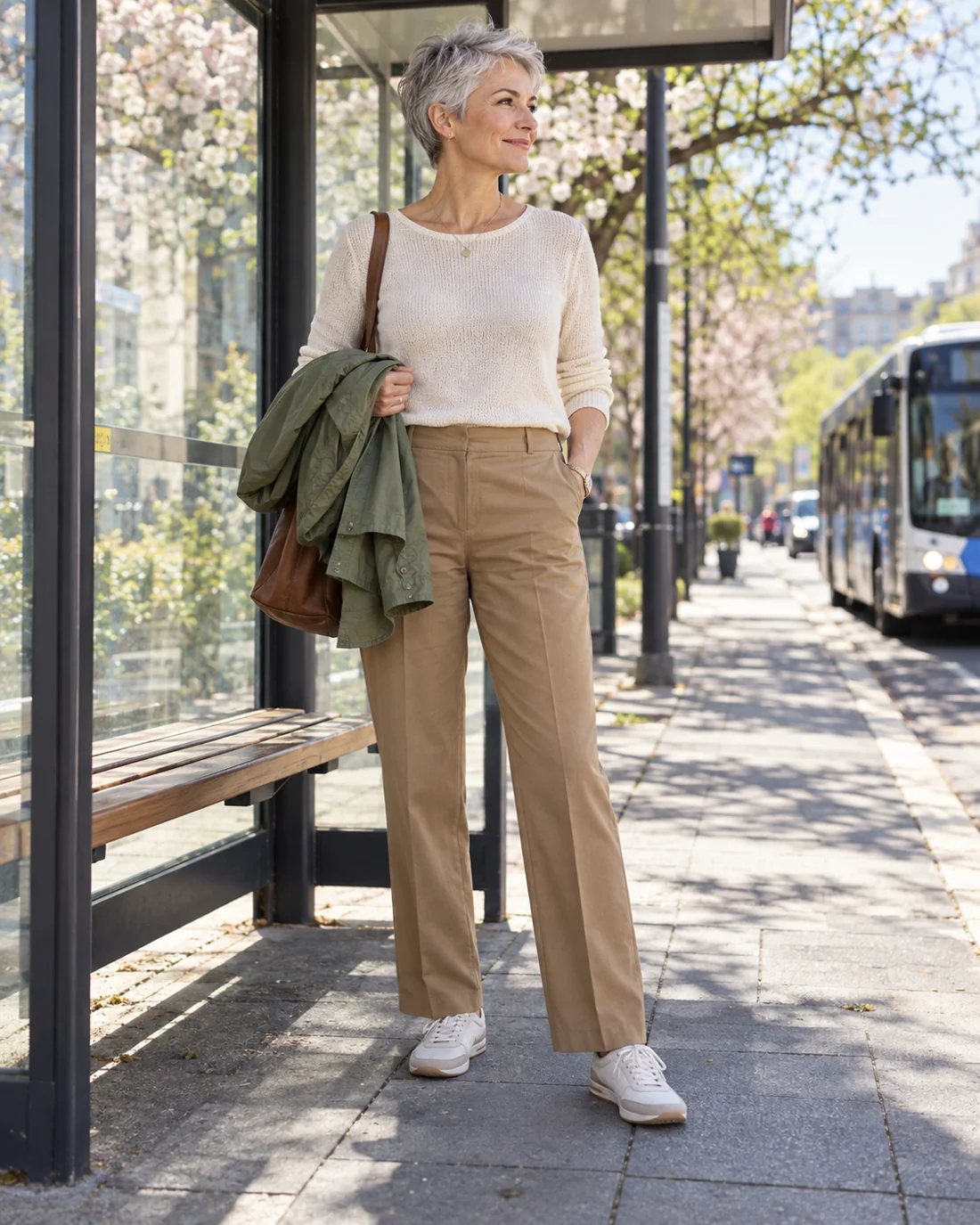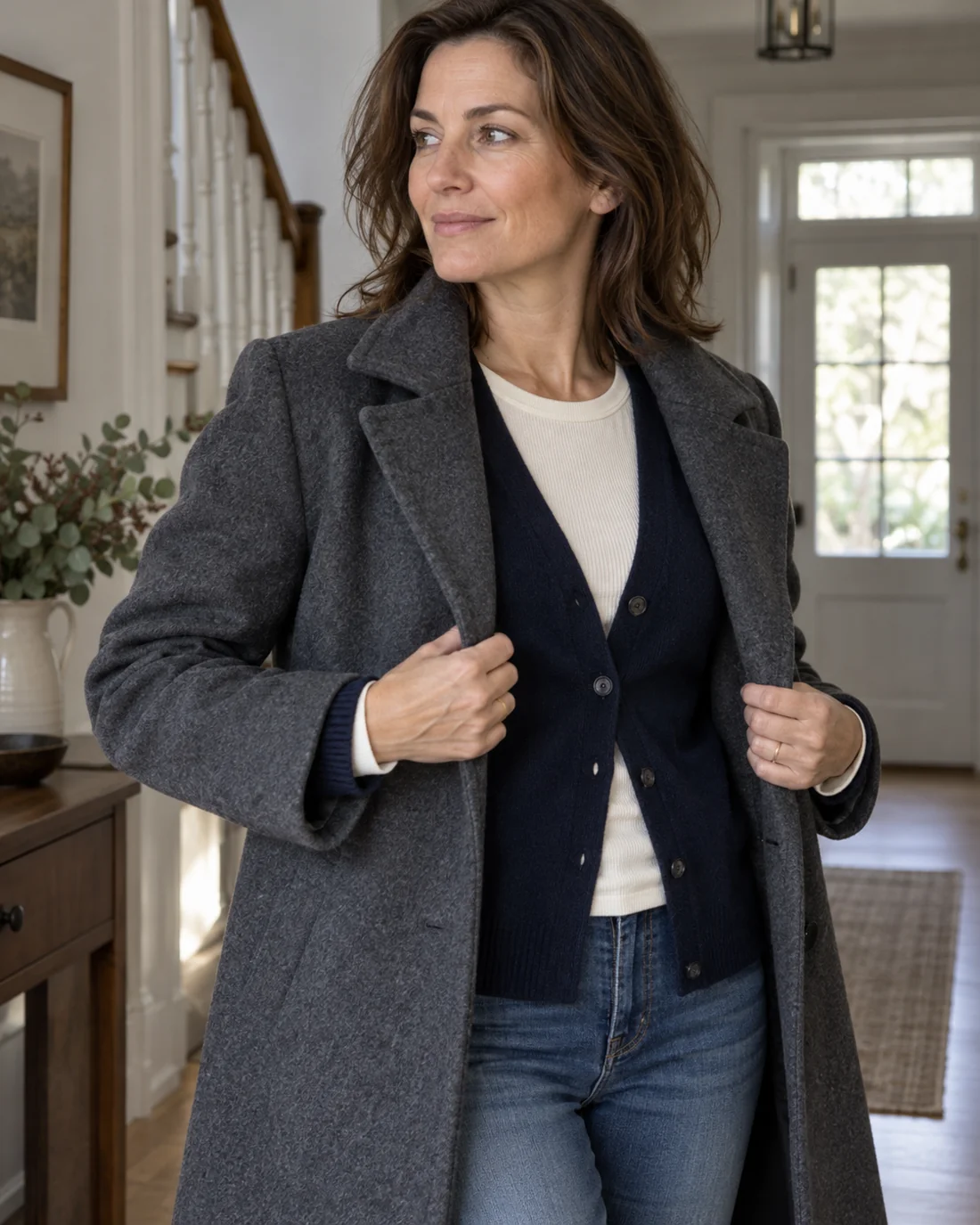
Treat the coat as a fixed outside shape
First put on the top that has previously fitted comfortably beneath the coat. Close the intended buttons or zip and move your arms forwards. Notice where room is already limited: shoulders, upper arms, chest or hips. This is more precise than simply saying the whole coat is too small or too large.
Then sit on an ordinary chair. A long coat can gather beneath you or pull at its lower fastening. Some designs can open from the bottom; use only their intended construction. Avoid relying on an unusual fastening arrangement that comes loose at every movement outside.
Arrange the first layer smoothly
A thin inner layer should feel comfortable without forming thick bundles of folds. Smooth it across the back and sleeves before adding knitwear. If the tee already rides up or twists on its own, another layer will not reliably correct that behaviour.
The neckline needs to remain comfortable without the coat too. A high collar under another high collar may collect too much material around the neck. Try a different neckline if pressure occurs there. You do not need to replace the entire outfit when one join is causing the difficulty.
Compare two jumpers
Take a dropped-shoulder jumper and one with a narrower sleeve setting if you own both. Try each over the same inner layer and beneath the same coat. The first may occupy more shoulder space despite using thinner fabric. The second may create a smoother outline without being inherently warmer or better.
Photograph the fastened coat front, then test movement rather than judging only the picture. Small visible folds are not automatically a problem. Pressure, restricted reach or a fastening opening under tension are concrete signals instead. Separate those observations from a wish for a perfectly smooth silhouette.
If both jumpers fit comfortably, choose by surface and the indoor outfit. If neither fits, the next question is not immediately a larger size. The coat construction may be unsuitable for those layers, or another existing arrangement may work better. Keep the results as specific combinations rather than broadly discarding individual garments.
Choose the jumper by shape
Large stitches are visible, but actual volume is the important question. A wide sleeve can cause more difficulty beneath a narrow coat sleeve than a denser, smoother knit. Place two existing jumpers side by side and compare sleeve width, shoulder shape and hem. Choose the one that works better inside the coat rather than judging fabric thickness alone.
A long jumper hem may bunch at a trouser waistband, particularly when the coat presses over it. Check whether it is pushed upwards when you sit. A shorter or straighter-cut version may simplify the arrangement. Again, this does not prescribe a body proportion; it concerns fabric moving between two other garments.
With a cardigan, consider buttons or a zip. Several hard fastenings stacked together can press when seated. Do not painstakingly offset the layers if another piece you already own resolves the problem more easily.
Remember sleeves and cuffs
Place the inner sleeves fully where you want them before putting on the coat. Afterwards, they should not be pushed so far upwards that you have to retrieve them through narrow openings. A visible cuff can belong to the outfit but should not hang loosely over the hand if that interferes with your activities.
Test gloves and the bag strap too. A strap over an already close shoulder can increase pressure. Carry the bag with its normal contents rather than empty. This shows whether the combination remains comfortable during ordinary walking.
When the coat lacks space
Do not force in another layer that compromises movement or fastening. A different jumper may fit, or perhaps another coat you already own. Longer periods outside may call for different clothing according to the actual conditions. A styled combination does not replace equipment suited to the weather.
Record a successful arrangement with every layer included. Note not just the visible colour but which thin tee sat beneath which jumper. Those details determine whether you can repeat the outfit on the next cold day. A photograph of the fastened coat alone cannot show them. Keep the note short enough to be useful while dressing, rather than turning it into a fixed formula for every winter situation.